


Kentucky lawmakers will enter the 2026 budget session facing a projected budget shortfall—but one that is significantly smaller than earlier estimates and more manageable than initially feared, according to updated revenue projections released this week.
The state’s Consensus Forecasting Group (CFG) on Tuesday revised its revenue outlook for the remainder of the current fiscal year and adopted official revenue estimates for FY2027 and FY2028. While revenues are expected to dip modestly in the near term, forecasters now anticipate steady growth over the next biennium, offering some legislators relief as they begin crafting the next two-year budget.
The CFG is a statutorily required, independent panel of citizens with economic expertise whose estimates are relied upon by the General Assembly in developing the state budget.
General fund outlook
Uncertainty continues to surround the upcoming biennial budget, as lawmakers weigh potential impacts from anticipated federal policy changes affecting Medicaid and the Supplemental Nutrition Assistance Program (SNAP). Even so, the CFG projects that general fund revenues will stabilize and grow modestly following a small decline in FY2026.
The group revised its general fund revenue estimate for FY2026 to $15.498 billion, a 1.3% decrease from FY2025. That revision results in a projected $156 million shortfall compared to the enacted budget—roughly half the $305 million gap estimated in September.
In response, Gov. Andy Beshear announced plans Thursday to further reduce the FY2026 general fund shortfall by proposing a 3% reduction in most state agencies’ enacted budgets.
Looking ahead, the CFG adopted official general fund revenue estimates of $15.882 billion for FY2027 and $16.232 billion for FY2028, representing year-over-year growth of 2.5% and 2.2%, respectively.
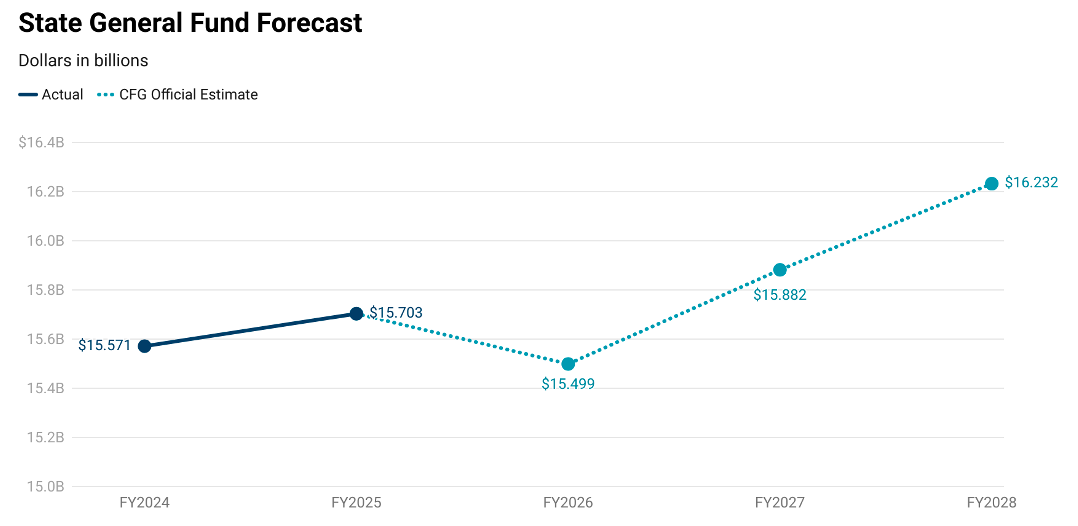
The estimates reflect the scheduled reduction of the individual income tax rate from 4% to 3.5%, effective Jan. 1, 2026. Despite the lower rate, individual income tax revenues are still expected to increase by 2.6% in FY2027 and 2.5% in FY2028.
Sales and use tax revenues are also projected to continue steady growth, increasing by 3.1% in FY2027 and 2.9% in FY2028.
Coal severance revenue projections
Coal severance tax revenues are expected to decline sharply over the biennium, raising concerns for coal-producing counties that rely heavily on those funds.
The CFG projects a 17.7% decrease in coal severance revenues in FY2027, bringing collections to $45.5 million, followed by an additional 18.6% drop in FY2028 to $36.9 million.
Road Fund outlook
While the general fund shows modest growth beyond FY2026, the Road Fund is expected to remain under pressure in the near term before rebounding in FY2028. The bulk of Kentucky’s Road Fund is supported by revenue from the motor fuels tax, vehicle usage tax, licensing fees and motor vehicle–related privilege taxes.
The CFG revised Kentucky’s Road Fund revenue estimate for FY2026 to $1.844 billion, a 1% decrease from FY2025. That revision results in a projected $50.3 million shortfall compared to the enacted budget—smaller than the $82.1 million gap forecast in September.
For the upcoming biennium, the CFG adopted official road fund revenue estimates of $1.836 billion for FY2027, a 0.4% decrease, and $1.909 billion for FY2028, a 4% increase.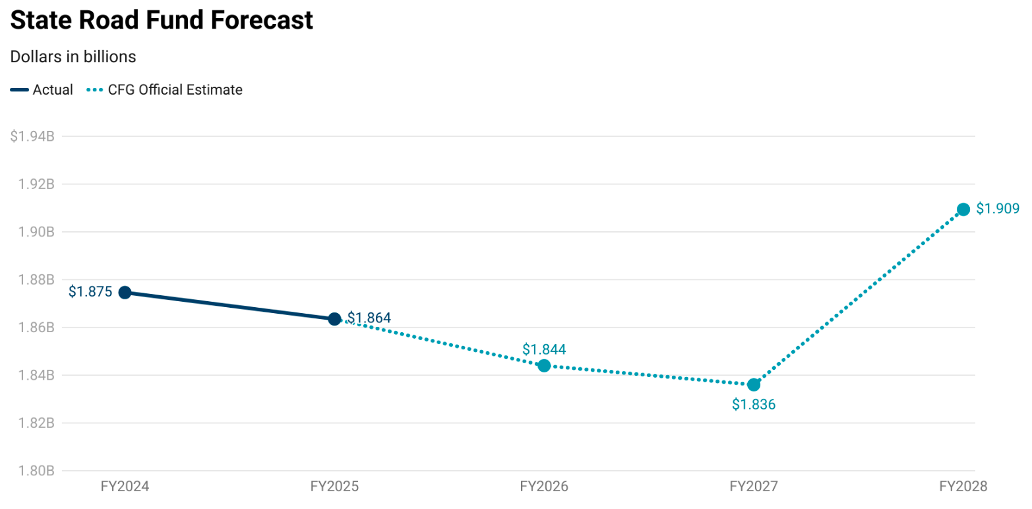
Motor fuels tax pressures
Declining motor fuels tax revenues is the primary driver of the Road Fund downturn in FY2026 and FY2027.
Motor fuels tax revenues are expected to fall 3.6% in FY2026 following an automatic 1.4-cent-per-gallon reduction in the tax rate on July 1, 2025, lowering the rate to 26.4 cents per gallon. That decrease was triggered by a decline in the average wholesale price of gasoline.
The current forecast assumes the motor fuels tax rate will remain unchanged in FY2027; however, declining fuel consumption is expected to result in a 4.7% drop in revenues that year.
Motor fuels tax receipts are projected to increase by 5.2% in FY2028 as the tax rate rises based on forecasted wholesale prices. Even with that increase, revenues are still expected to remain $96.8 million below FY2024 levels.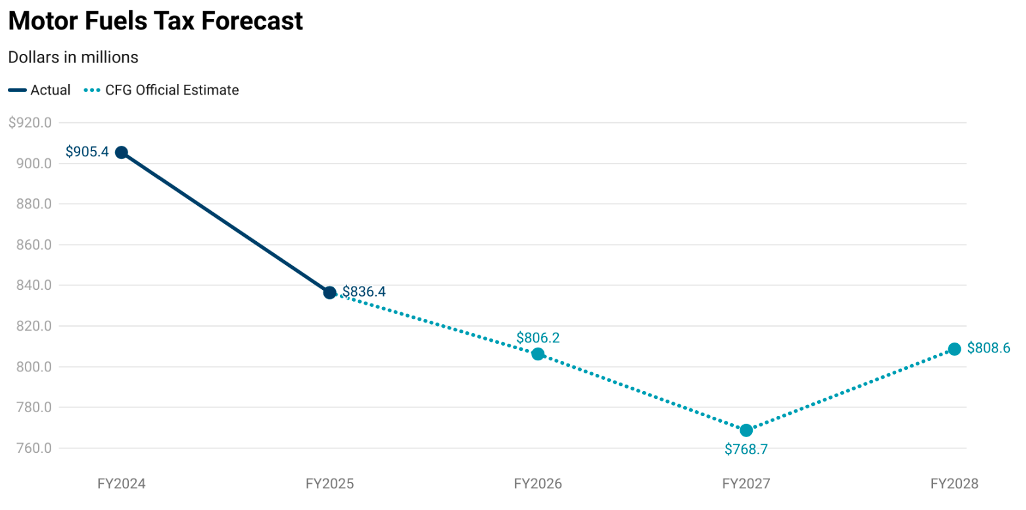
Declining motor fuels tax revenues will have direct consequences for counties. Counties receive 18.3% of Kentucky’s motor fuels tax receipts through the county road aid revenue-sharing program, which serves as their primary source of road funding.
The anticipated declines will compound existing challenges, as county road aid has not kept pace with inflation over the past decade.


