


Under Kentucky law, counties are responsible for housing individuals arrested within their jurisdiction (KRS 441.800). To meet this obligation, two or more counties may partner to establish a regional jail authority (RJA).
RJAs are created by ordinance of participating counties and governed by a multi-county board rather than a single fiscal court. Under current statute, the board consists of:
- Three appointees selected by the judge/executive of the most populous participating county
- Two appointees selected by the judge/executive of each remaining participating county
- The jailer of the county in which the RJA facility is located (KRS 441.810)
Note: KACo’s comprehensive jail proposal (HB 557) would automatically include the jailer of each participating county on the RJA board.
Existing regional jail authorities
There are currently four regional jail authorities in Kentucky:
- Big Sandy Regional Detention Center – Johnson*, Lawrence, Magoffin, Martin
- Bourbon County Regional Jail – Bourbon*, Nicholas
- Kentucky River Regional Jail – Knott, Perry*
- Three Forks Regional Jail – Lee*, Owsley, Wolfe
*County where the RJA facility is located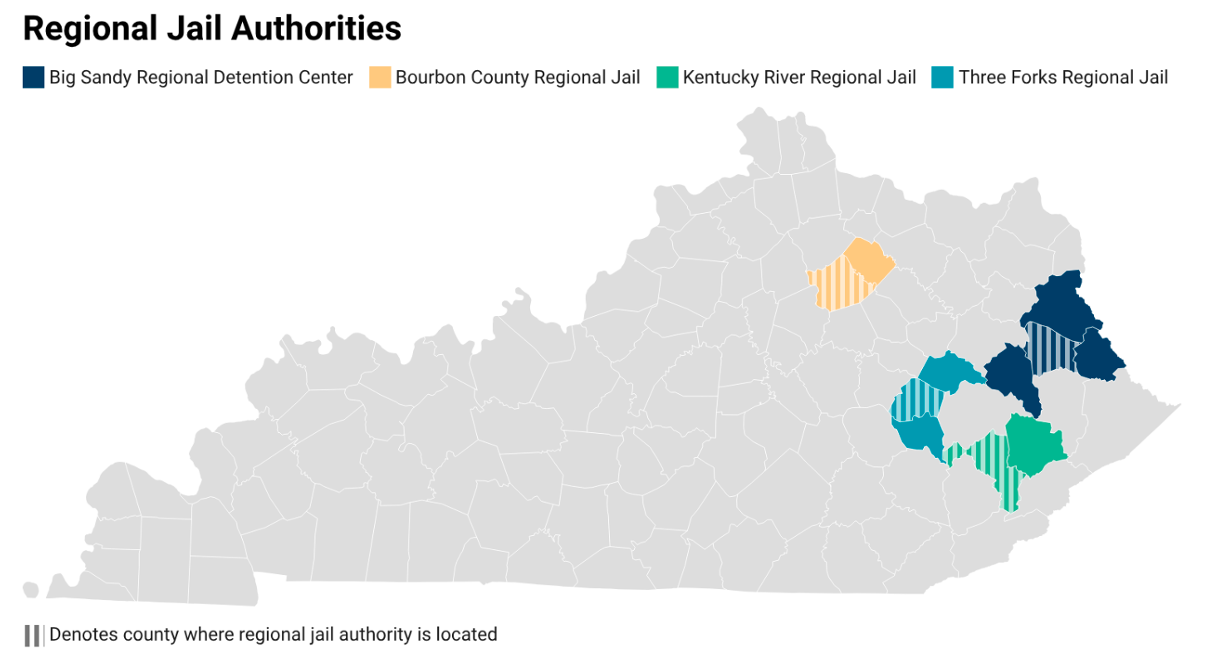
What does regional mean?
Currently, 43 counties in Kentucky do not operate a jail and must contract with other counties to house their inmates. Many county jails house inmates from other counties through contractual agreements. Some of these facilities include the word “regional” in their jail’s name because they house inmates from multiple counties; however, that designation alone does not mean the facility is operated by a regional jail authority.
The key distinction of regional jail authorities lies in ownership and management.
Most Kentucky jails are owned by a single county fiscal court and operated under the custody of that county’s elected jailer. By contrast, an RJA is owned collectively by a multi-county board, which appoints a jail administrator to oversee day-to-day operations.
Is a regional jail authority the right fit for my county?
RJAs can be a useful tool for counties seeking to achieve economies of scale, share operational responsibilities and collaborate to meet their statutory incarceration responsibilities.
However, they are not a one-size-fits-all solution and may not be the best option for every county. Decisions about forming or joining an RJA are best made at the local level, as county officials have the most insight into transportation logistics, inmate populations, financial commitments and other operational considerations.
Note: KACo’s comprehensive jail proposal (HB 557) provides one-time incentives for counties that establish a new or join an existing RJA and establishes a formal process for RJAs to seek state funding for new facility construction and facility expansion or improvements.


